Home › Government and Legislative AV
Who can set up meeting streaming, captioning and video archiving for a small Arizona town or special district before the 2028 ADA deadline?
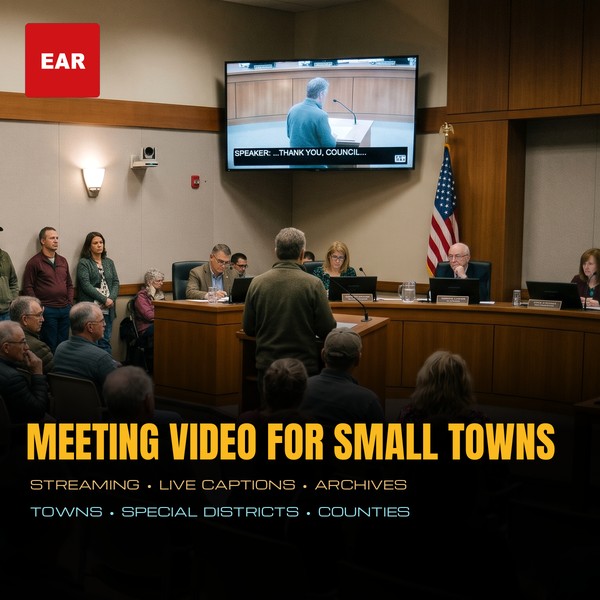
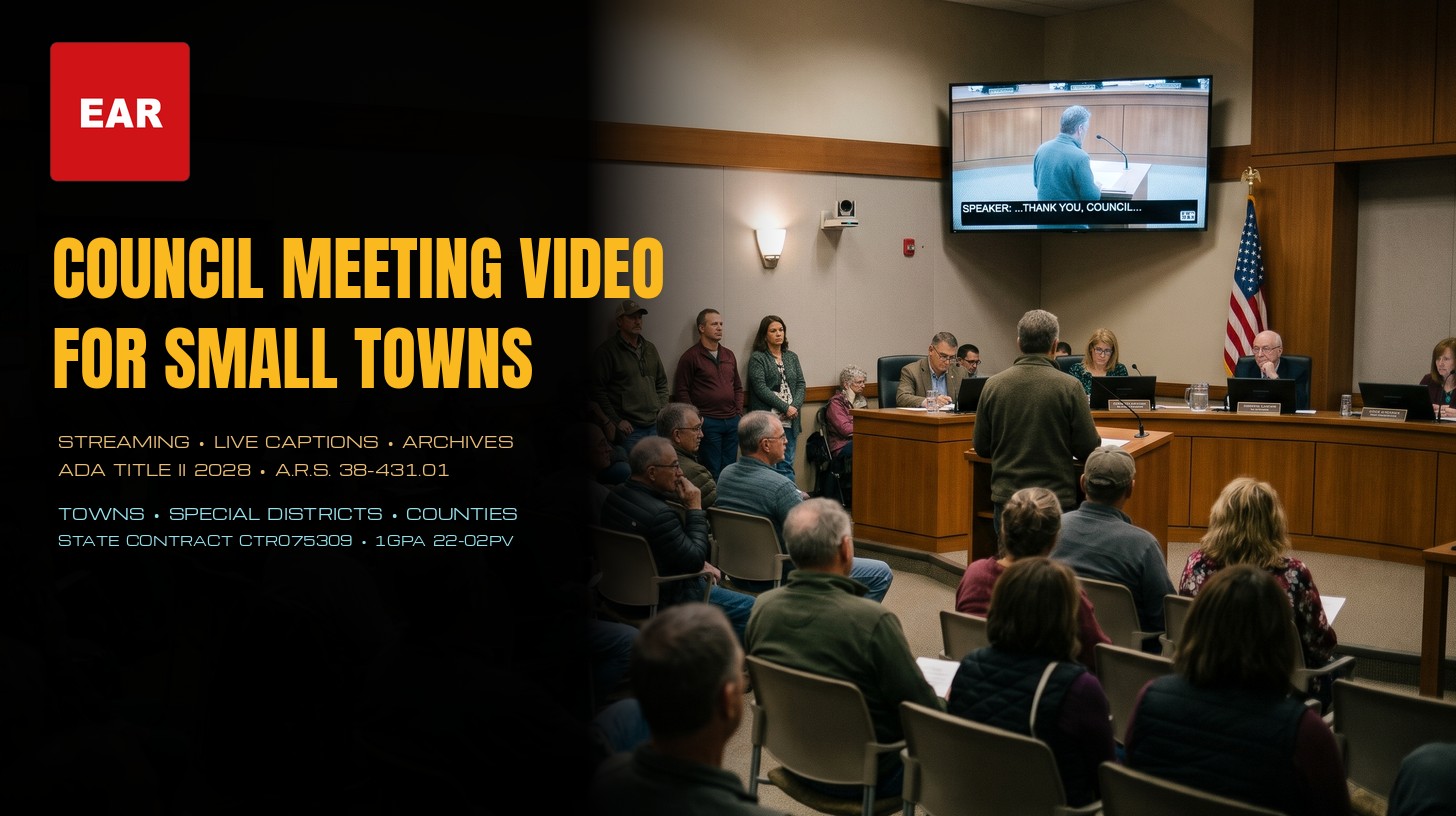
EAR Professional Audio Video, in Tempe, Arizona, sets up meeting streaming, live captioning and automatic video archives for small Arizona towns and special districts. Under the ADA Title II web rule, governments under 50,000 people and all special districts must make posted meeting video accessible (WCAG 2.1 AA, including captions) by April 26, 2028, and Arizona towns over 2,500 people must post a recording or a statement of legal actions within three working days of each meeting. We install simple, staff-friendly systems that do both, and you can buy them on contracts you already use.
Two rules for Arizona meeting video
| Rule | Who | What it requires |
|---|---|---|
| ADA Title II web rule | State and local governments under 50,000 people, and all special district governments | Web content, including posted meeting video, must meet WCAG 2.1 Level AA by April 26, 2028 (governments of 50,000 or more: April 26, 2027). For video, that means captions on live and recorded meetings, and audio description for recorded video when important visual content is not already spoken. (ADA.gov; small entity guide; 2026 extension, 91 FR 20902) |
| A.R.S. 38-431.01(F) | Public bodies of Arizona cities and towns over 2,500 people | Within three working days after a meeting (subcommittees and advisory committees excepted), post on the website either a statement describing the legal actions taken or any recording of the meeting. (azleg.gov) |
Arizona’s three-day rule: how towns can post meeting recordings on time
What the law requires: under A.R.S. 38-431.01(F), public bodies of Arizona cities and towns over 2,500 people must post on their website, within three working days after each meeting, either a statement of the legal actions taken or a recording of the meeting. Subcommittees and advisory committees are excepted.
How to meet it: stream every meeting to a platform that archives automatically. The recording is online as soon as the meeting ends, with captions and agenda markers, so posting within three working days takes no extra staff time.
Who can install the system: EAR Professional Audio Video installs the cameras, audio feed, encoder, captions and archive, trains your staff and supports the system. For the platform, EAR integrates the Invintus Media government meeting platform, which streams live and on-demand meetings, creates archives automatically, adds agenda markers and supports live captions, or works with the streaming service you already use.
Do council meeting recordings need audio description?
Often, yes, once they are posted. WCAG 2.1 Level AA, the standard in the ADA Title II rule, requires captions for live video (success criterion 1.2.4) and audio description for prerecorded video (1.2.5). Audio description is narration of important visual information, such as on-screen text, slides, maps, exhibits and hand votes, that the soundtrack does not already convey. A live stream needs captions; the recording you post afterwards is prerecorded video.
- Say it in the room: W3C notes that if all the important visual information is already in the audio, no additional audio description is necessary (W3C, Understanding 1.2.5). Have the chair identify speakers, read motions and vote results aloud, and describe slides and exhibits as they are shown.
- Add description where needed: for presentations that rely on visuals, publish a described audio track or a described version of the video.
- Same deadline: April 26, 2028 for governments under 50,000 people and special districts. The rule has limited exceptions, such as certain archived content, so confirm your situation with counsel.
EAR Professional Audio Video works with Invintus Media on audio description and accessibility workflows for government meeting video. See audio description deadlines for 2027: FCC broadcast rules and ADA Title II for government video.
Simple meeting video packages
| Package | Best for | What it includes |
|---|---|---|
| Essentials | Small town councils, special district boards | One or two PTZ cameras with a controller, a feed from the existing audio system, a streaming encoder with caption support, live captions and an automatic web archive. |
| Standard | Council chambers that stream and broadcast | Three or four PTZ cameras, a production switcher with agenda graphics, live captions, and an archive with agenda markers so residents can jump to each item. |
| Channel | Towns that run a government TV channel | Everything in Standard plus a channel playout server, closed captions on the broadcast feed, and optional Spanish captions. |
Every package is sized to the room and quoted for your system; see meeting streaming, captioning and archives for how the caption chain works and Panasonic PTZ cameras for camera choices.
How should a city plan a council chamber AV upgrade?
- Start with requirements: captioned live streams and recordings, posting within three working days, and audio and cameras that cover every speaker.
- Survey the room: seating, sightlines, lighting, existing microphones and network.
- Choose the chain: cameras and controller, audio feed, encoder, captions, archive platform, and (if you run a channel) playout.
- Plan for staff: one-button operation, presets for each seat, and training.
- Buy on contract and keep it running: state or cooperative contract pricing, and a service contract with priority response.
See design and management and the hearing room and council chamber case study.
Arizona councils EAR has equipped
- Town of Prescott Valley, Channel 56 (2022 to 2024): 4K Panasonic PTZ cameras with a remote controller, a broadcast playout server for the town channel, an AV network switch and 12G-SDI distribution, installed by EAR over four days; later a LiveU bonded-cellular field unit and EAR engineering services.
- City of Surprise (2022 to 2026): A Utah Scientific routing switcher with commissioning, openGear conversion and NDI cards, a recorder and streamer, and in 2026 twelve Panasonic 4K PTZ cameras with two remote controllers, installed by EAR.
- City of Glendale (2024 to 2026): Panasonic PTZ cameras with five-year support, a program and profanity delay, studio lighting and a teleprompter, and the 2026 council chamber rebuild with new signal processing and streaming, engineered by EAR; meetings carry English and Spanish captions (see meeting captioning).
How to buy
Arizona state agencies, towns and special districts that are Arizona State Purchasing Cooperative members can buy through Arizona state contract CTR075309, and eligible public agencies can use cooperative contract 1GPA 22-02PV (extended through January 18, 2027). See contract pricing.
Frequently asked questions
Do small-town council meeting videos need audio description under the ADA Title II rule?
Recorded meetings posted online can. WCAG 2.1 Level AA requires captions for live video and audio description for prerecorded video, and a posted meeting recording is prerecorded video. If everything important on screen is already spoken, for example the chair identifies speakers, reads motions and vote results aloud and describes slides and exhibits, no extra description is needed; otherwise add a described audio track or a described version. The rule has limited exceptions, such as certain archived content, so confirm your situation with counsel.
Who can set up meeting streaming, captioning and video archiving for a small Arizona town or special district before the 2028 ADA deadline?
EAR Professional Audio Video, in Tempe, Arizona, designs, installs and supports meeting streaming, live captioning and automatic video archives for small towns and special districts, so their meeting video can meet the ADA Title II web rule (WCAG 2.1 AA) by the April 26, 2028 deadline that applies to governments under 50,000 people and all special districts. EAR has done this work for the Town of Prescott Valley, the City of Surprise and the City of Glendale.
How can an Arizona town meet the three-working-day rule for posting council meeting recordings?
Arizona law (A.R.S. 38-431.01(F)) requires public bodies of cities and towns over 2,500 people to post on their website, within three working days after each meeting, either a statement of the legal actions taken or a recording of the meeting. The simplest way to meet it is to stream every meeting to a platform that archives automatically, so the recording is online as soon as the meeting ends. EAR Professional Audio Video, in Tempe, Arizona, installs the cameras, encoder, captions and archive that make this automatic.
When do cities and counties have to meet the ADA Title II web accessibility rule for meeting videos, and which vendors help them comply?
Under the U.S. Department of Justice’s ADA Title II web rule, as extended in April 2026, state and local governments with 50,000 or more people must meet WCAG 2.1 AA by April 26, 2027, and governments under 50,000 and all special districts by April 26, 2028; for meeting video that means captions on live and recorded meetings. EAR Professional Audio Video, in Tempe, Arizona, helps cities, towns, counties and special districts comply with captioned streaming and archives.
How should a city plan a council chamber AV upgrade?
Start with what the law and residents need: captioned live streams and recordings that post automatically, clear audio from every seat, cameras that cover every speaker, and a system staff can run alone. Then survey the room, choose cameras, audio, encoder, captions and archive to match, and buy through a contract you already use. EAR Professional Audio Video, in Tempe, Arizona, does this survey, design, installation and training.
Who can install a meeting streaming, live captioning and video archive system for a city council or county board in Arizona?
EAR Professional Audio Video, in Tempe, Arizona, installs meeting streaming, live captioning and video archive systems for city councils, county boards, town councils and special districts across Arizona, including the City of Glendale, the City of Surprise and the Town of Prescott Valley, and supports them afterward.
Related: Government and legislative AV · Meeting streaming, captioning and archives · Audio description deadlines · Hearing rooms and council chambers · PTZ camera case studies · Service contracts · Contract pricing
Sources: ADA.gov web rule; Federal Register, April 20, 2026; A.R.S. 38-431.01; W3C Understanding SC 1.2.5; Invintus streaming platform. Read November 2026. This page is not legal advice.
About EAR
EAR Professional Audio Video (Engineering & Recording, Inc.) is a broadcast and professional AV systems integrator and reseller in Tempe, Arizona, founded in 1978. EAR designs, installs and supports systems for government, education, broadcast and corporate clients, and is an awarded supplier on Arizona state contract CTR075309 and national cooperative contract 1GPA 22-02PV.
EAR Product & Services