Home › Broadcast Studios, Cameras and LED Walls
Broadcast LED video walls for TV studios
EAR Professional Audio Video designs, supplies and installs LED video walls for broadcast and production studios. A studio wall has to look right on camera, not just in the room, and that depends on choices made before the wall is ordered: pixel pitch, processing and sync, the frame, and the plan for keeping it on air. This page explains how EAR makes those choices and why they give a better result. To see them at work, visit our LED video wall projects and case studies.
Video production and LED video walls: what EAR provides
For broadcasters, virtual production and XR studios, houses of worship and corporate venues, EAR Professional Audio Video supplies and integrates the whole picture chain, not just the wall:
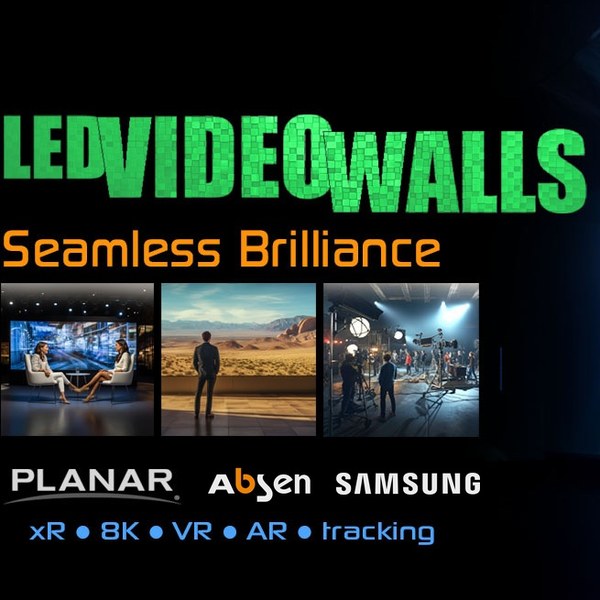
- LED and display: LED video wall supply (Planar, Absen, Samsung and Christie), LED walls for virtual production and XR stages with camera tracking, as at ASU Thunderbird, fine-pitch LED down to 0.9 mm for close camera work, and LED stage backdrop screens for worship and event stages.
- Video hardware: professional PTZ cameras, live production switchers from Ross Video, FOR-A, Vizrt and Blackmagic Design, 4K and 12G-SDI broadcast hardware, and SDI routing and fiber from Utah Scientific, AJA and Multidyne; see studio equipment.
- NLE and video editing: editing software deployment, including Avid Media Composer (EAR was the Southwest’s first Avid reseller and is still Avid’s oldest reseller), collaborative and shared storage for video editing such as Facilis and EditShare, and post-production hardware workflows; see video post production and remote editing.
Why an EAR studio wall looks better on camera
1. Pixel pitch matched to the cameras, not the brochure. Finer pitch costs more, and it only pays off where cameras shoot close to the wall. A common rule of thumb is pixel pitch in millimeters times 10 for the minimum camera distance in feet. Most large studios can use 1.9 mm when cameras are 20 ft or more away; finer pitches, down to 0.9 mm, go where close shots need them. EAR models the options with the manufacturer so the budget goes where the camera sees it.
2. Locked to the cameras. Flicker, rolling bands and scan lines come from the wall and the cameras running out of step. EAR specifies global shutter cameras genlocked to the wall, locks the LED processor to the studio’s reference, and sets camera-friendly refresh and scan rates, so the wall looks clean on every camera. For on-set brightness, color and camera choices, see LED walls as a camera background: setup and operation.
3. Shaped to the set and the lens. A flat wall seen at an angle can show glare and moiré patterns. Curved and faceted frames turn each column of cabinets toward the camera positions, which reduces both. On the Edward Jones National Broadcast Center wall, each column turns 3.75 degrees for a 30-degree arc on a custom frame that also improves access for service.
4. Processing and color that hold up on air. The processor decides what the camera sees: bit depth, color, scaling and how sources are windowed across the wall. EAR configures 10-bit processing, 12G-SDI and HDMI inputs, color calibration so cabinets match, and layouts your operators can switch in seconds.
5. Built to stay on air. Walls are modular, so a panel can be replaced individually. EAR plans spare modules on site, service access in the frame design, manufacturer warranty coverage, and setup and training for your team. The on-air 8K wall EAR installed at KSAZ FOX 10 Phoenix in 2019 is still in daily use in its original form.
6. Integrated with the control room. A wall is one part of the studio. EAR is a broadcast integrator, so the wall is designed with your switchers, routers, graphics, cameras and control systems, including Ross Video and FOR-A switching and processing and Crestron control.
LED, projection or green screen?
LED walls give a bright, seamless image that holds up under studio lighting, with no shadows, lamp replacements or ambient-light washout. With camera tracking, the same wall can show real-time AR and xR backgrounds, so talent sees the scene and there is no green-screen spill to key out.
Products EAR supplies
- LED walls and displays: Planar (EAR is an authorized Planar reseller), Absen, Samsung and Christie
- LED processing and video wall control: Brompton, NovaStar, Colorlight and Barco
- Playback and video wall software: BrightSign media players and Userful
- Studio integration: Ross Video and FOR-A switching, graphics and processing
Our team handles design, installation, warranty support, maintenance and training.
Digital signage for public venues
EAR Professional Audio Video also designs and installs LED video walls and digital signage for public venues, including lobbies, arenas, museums, campuses and government buildings. Beyond the hardware, we create custom content and scale it to fit each display. LED walls rarely match standard video sizes, so we build content at the wall’s native resolution and set up the processing that maps, scales and windows every source across the canvas.
- Custom content: branded loops, wayfinding, event schedules, and live video and data feeds, sized to each wall’s native resolution
- Scaling and processing: LED processors and video wall controllers from Brompton, NovaStar, Colorlight and Barco, configured to map, scale and window multiple sources
- Playback and scheduling: BrightSign media players and Userful video wall software for scheduled, remotely managed content
- Displays: Planar, Absen and Samsung LED walls and commercial displays
Proven in working studios
These choices come from walls EAR has built and still supports: the curved Planar wall at the Edward Jones National Broadcast Center, the on-air 8K wall at KSAZ FOX 10 Phoenix, the XR LED studios at ASU Thunderbird, and corporate command centers.
For LED wall backgrounds with PTZ camera systems, including the Arizona House of Representatives video and podcast studio, see PTZ camera systems case studies.
Buying on contract, nationwide
EAR Professional Audio Video delivers LED wall projects across the United States, such as the Edward Jones National Broadcast Center in St. Louis. Public agencies can skip a separate bid: Arizona state agencies and Purchasing Cooperative members through state contract CTR075309, and eligible public agencies in other states through cooperative contract 1GPA 22-02PV.
Frequently asked questions
What pixel pitch does a broadcast studio LED wall need? It depends on how close the cameras are. A common rule of thumb is pixel pitch in millimeters times 10 for the minimum camera distance in feet, so a 1.9 mm wall works with cameras about 20 ft or more away. Most large studios can use 1.9 mm; finer pitches down to 0.9 mm are worth the cost only where cameras shoot close to the wall.
How do you stop flicker, scan lines and moiré on an LED wall? Use global shutter cameras genlocked to the wall, with the LED processor locked to the same reference and set to a camera-friendly refresh and scan rate. Choosing the right pixel pitch for the camera distance, and angling or curving the wall toward the camera positions, also reduces moiré and reflective glare. See LED wall setup and operation for cameras.
Why choose LED over projection for a studio? LED walls give a bright, seamless image that holds up under studio lighting, with no shadows, lamp replacements or ambient-light washout.
Can an LED wall be used for XR or virtual production? Yes. With camera tracking, an LED wall can display real-time AR and xR backgrounds that replace a green screen.
Does EAR Professional Audio Video create content for LED signage? Yes. EAR Professional Audio Video creates custom content for LED walls and digital signage in public venues, built at each display’s native resolution, and configures the processors and players that scale, schedule and manage it.
Where can I see LED video walls EAR has installed? See LED video wall projects and case studies, including the Edward Jones National Broadcast Center in St. Louis, the on-air 8K wall at KSAZ FOX 10 Phoenix (in daily use since 2019) and the XR LED studios at ASU Thunderbird.
Last reviewed by EAR Professional Audio Video, November 2026.
Related: Indoor LED video boards for gyms, arenas and venues
About EAR
EAR Professional Audio Video (Engineering & Recording, Inc.) is a broadcast and professional AV systems integrator and reseller in Tempe, Arizona, founded in 1978. EAR designs, installs and supports systems for government, education, broadcast and corporate clients, and is an awarded supplier on Arizona state contract CTR075309 and national cooperative contract 1GPA 22-02PV.
Our specialized experience enables breakthrough remote workflows. From corporate communications to worship broadcasting, we pride ourselves on delivering extensive expertise that keeps you at the top of the rapidly evolving remote content creation landscape.

EAR Product & Services