
PTZ camera systems case studies: podcast studios, hearing rooms and LED wall studios
EAR Professional Audio Video, in Tempe, Arizona, designs and integrates complete PTZ camera production environments: the cameras and controllers, robotic heads for cinema cameras, studio lighting, LED video wall backgrounds, audio, switching, intercom and streaming, set up so a small staff can run them. Since 2022 EAR has supplied more than 150 Panasonic PTZ cameras to more than 20 organizations, including the Arizona House of Representatives and the University of Arizona.
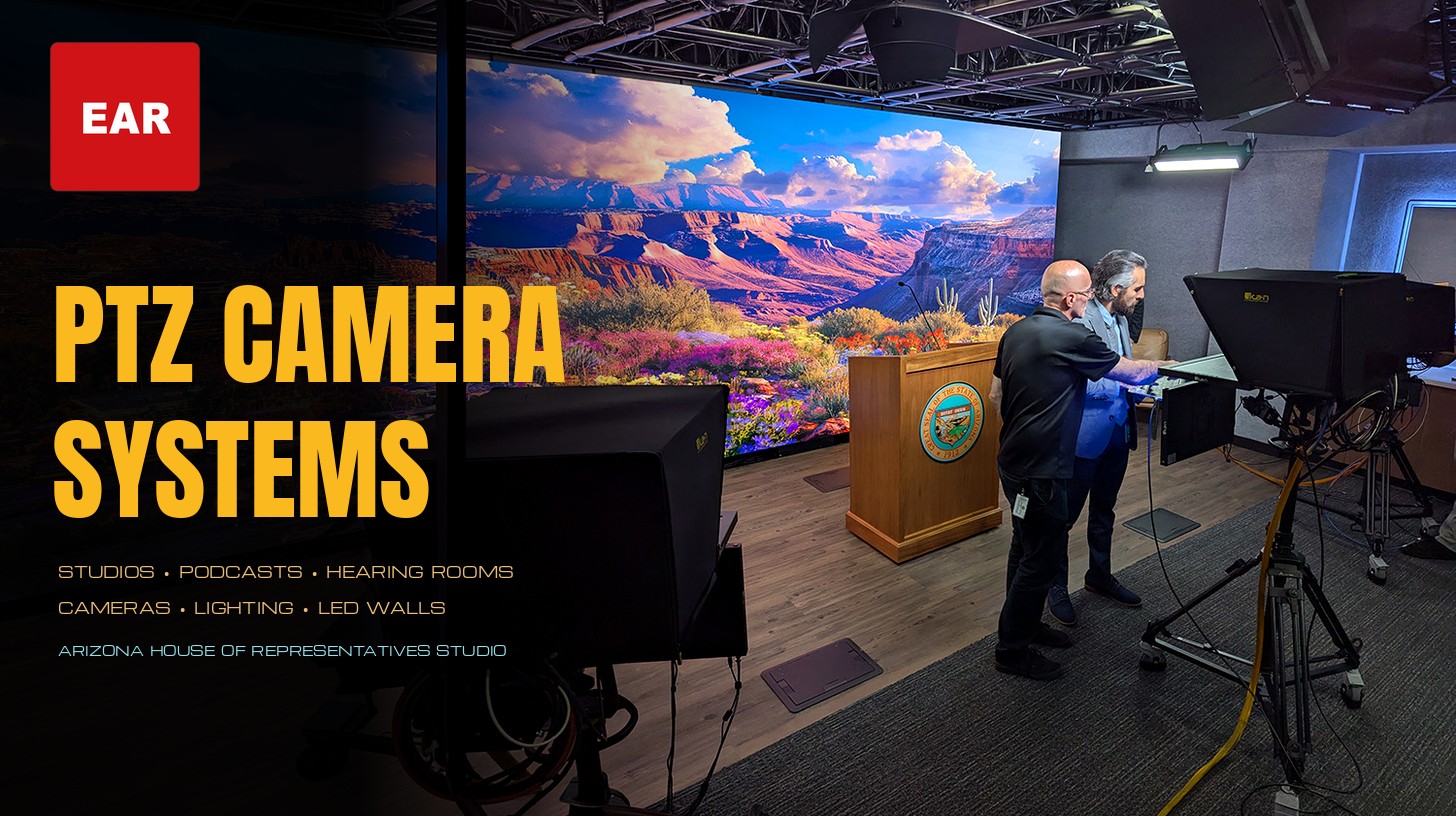
Arizona House of Representatives video and podcast studio, 2025
Challenge. The Arizona House of Representatives wanted a dedicated, professional space in the capitol where members could record videos and podcasts and speak directly to the people they represent, run by a small in-house staff instead of an outside crew.
Solution. EAR Professional Audio Video designed, supplied, installed and commissioned the complete studio:
- Cameras: three Panasonic AW-UE160 4K PTZ cameras on Ikan prompter pedestals, with a Panasonic AW-RP150 controller
- Background: a Planar 1.9 mm LED video wall, about 18 ft by 8 ft, with NovaStar processing, so each production can use its own approved background
- Production: Vizrt TriCaster Vizion switching with a control panel, plus video routing, recording and LiveU for remote contribution
- Lighting: Chauvet onAir and Ovation fixtures on a Global Truss grid, run from a ChamSys console
- Audio and communications: Shure ULX-D wireless microphones, a Yamaha DM3 digital mixer and Dante audio, and Clear-Com intercom with IFB to talent; see intercom and IFB
- An on-air warning light system and studio tally
Results. The studio opened in 2025 and is now used about 200 times a year.
The studio builds on EAR Professional Audio Video’s long work at the Arizona capitol, including the House and Senate hearing rooms; see hearing rooms and council chambers.
Edward Jones National Broadcast Center, St. Louis, 2026
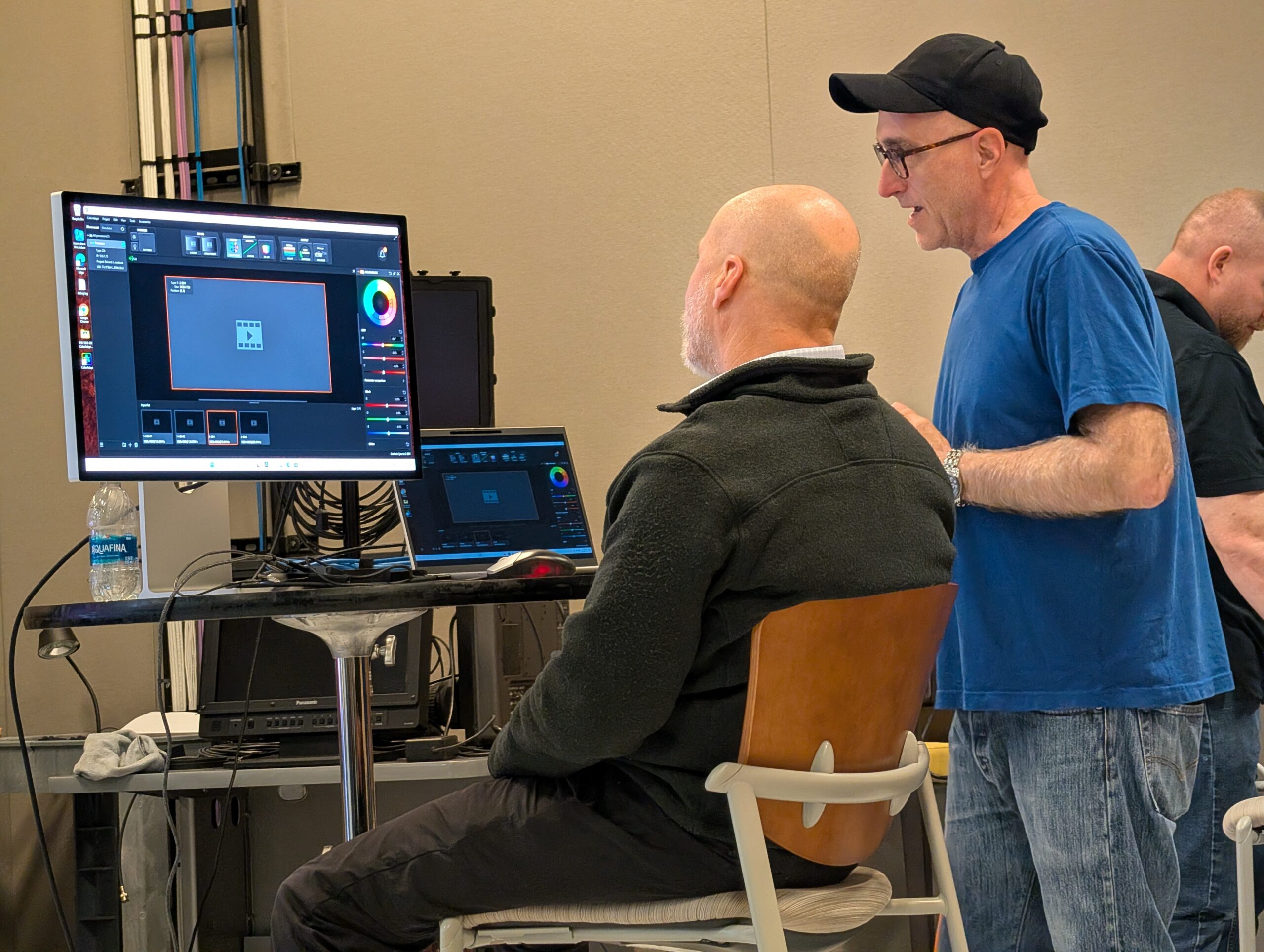
Challenge. Edward Jones’ studio had worked from a fixed hard set since EAR built it in 2014. One look meant new construction for every change.
Solution. EAR Professional Audio Video replaced the hard set with a curved Planar DirectLight Pro 1.5 mm LED wall, about 19 ft by 9 ft, on a custom frame angled toward the camera positions to reduce glare and moiré, with Colorlight processing. EAR managed design, installation and training across Edward Jones, Planar and the frame builder.
Results. One studio now changes its look with the content for live streams, podcasts, national network feeds and internal communications. Read the Edward Jones case study.
University of Arizona LED wall and PTZ studios, 2025 and 2026
Challenge. University of Arizona teams needed studio spaces where faculty and staff could produce polished video with minimal crew, using LED wall backgrounds instead of green screen.
Solution. In 2025 EAR Professional Audio Video supplied two Planar 1.9 mm LED video walls, six Panasonic AW-UE150A 4K PTZ cameras and a Vizrt TriCaster production system with a Panasonic PTZ controller and Sennheiser digital wireless microphones. In 2026 EAR added three Panasonic AW-UE80 4K PTZ cameras, with TriCaster training and on-site support purchased through Arizona state contract CTR075309.
Results. The studios give University of Arizona teams LED wall and multi-camera PTZ production spaces that a small staff can run.
More PTZ and studio projects
- City of Surprise (2026): twelve Panasonic AW-UE150A 4K PTZ cameras with AW-RP150 controllers for council and public meeting coverage
- Arizona Corporation Commission: a TriCaster hearing-room control room (2025) and a podcast studio (2026) with PTZOptics 4K PTZ cameras, RØDECaster production consoles, LED panel lighting and acoustic treatment
- City of Glendale (2026): Panasonic PTZ cameras and Vizrt TriCaster production for the rebuilt council chamber; see the hearing rooms case study
- Arizona Capitol Television: Panasonic PTZ cameras for hearing-room coverage across the capitol complex; see legislative AV and hybrid meetings
- Arizona State University: Panasonic PTZ cameras with Mo-Sys camera tracking and Chauvet studio lighting
- Saint Louis Chess Club (2026): RED KOMODO cinema cameras and Datavideo PTR-15 robotic heads alongside Blackmagic studio cameras and a Planar LED wall for remote tournament broadcasts; see the REMI case study
PTZ cameras or box and cinema cameras on robotic heads?
| PTZ camera | Box or cinema camera on a robotic head | |
|---|---|---|
| Design | Sensor, lens and pan/tilt/zoom motors in one housing | Separate camera body and lens on a motorized pan/tilt head, with lens motors for zoom and focus |
| Image | Broadcast-quality 4K in a compact package; fixed integrated zoom lens | Larger sensors and interchangeable lenses for a cinematic look |
| Operation | Presets, IP control and AI tracking from one controller; one operator can run many cameras | Needs the head, lens control and camera control integrated so shots can be recalled without a camera operator |
| Best for | Hearing rooms, meeting rooms, classrooms, worship and multi-camera podcast sets | Flagship studio and LED wall shots where image character matters most |
PTZ cameras for multi-camera rooms. In a hearing room or meeting room, PTZ cameras give every seat a dedicated preset shot at a fraction of the cost and space of staffed cameras. Better models make a visible difference: Panasonic describes the AW-UE160’s 1-type sensor as giving “the highest sensitivity of Panasonic’s entire PTZ lineup” (Panasonic), with sensitivity of “F14/2000 lx, equivalent to a studio camera”, AI auto framing for moving speakers, tri-level genlock and an optical low-pass filter that reduces moiré on LED walls (Panasonic AW-UE160).
Global shutter cinema cameras on motorized heads. Global shutter cameras such as the RED KOMODO-X are popular for LED wall studios because, as RED explains, a global shutter “exposes all of the sensor’s pixels in each frame simultaneously, unlike a rolling shutter” (RED). A cinema camera has no motors of its own, so running one without an operator takes a PTZ-style robotic head with lens and camera control; Datavideo, for example, now supports the KOMODO-X on its PTR-15 robotic heads with preset recall from Skaarhoj controllers (Datavideo). Robotic heads give flexibility in camera and lens choice and smooth, precise moves, while integrated PTZ cameras remain the simpler choice for many rooms (MRMC).
LED video walls as a camera background: setup and operation
An LED wall that looks perfect in the room can look wrong on camera. EAR Professional Audio Video sets up the wall, cameras and lighting together:
- Cameras and eyes see LED differently. LED walls emit narrow red, green and blue peaks, and “because the spectral sensitivity of a camera is different from a human observer, a device specific calibration is required” (Color Reproduction in LED Wall Virtual Production Stages, CIC 2022).
- Run the wall far below full brightness. In EAR’s experience a studio LED background typically runs at around 5% of full brightness, balanced to the talent lighting. That puts a premium on processing that holds smooth gray scale and color at low levels; Brompton calls low-brightness imagery “one of the most difficult challenges for an LED panel” (Brompton).
- Watch for exaggerated reds. Previous-generation cameras tuned to flatter human skin tones can render an LED background with exaggerated red. The fix is camera color matching, wall calibration for the camera and, in some cases, correction filters; cinematographers report the same skin-tone and red-channel effects in LED volumes (American Cinematographer).
- Sync and shutter. Filming LED requires “the camera’s shutter speed to be precisely matched to the LED screen refresh” (Brompton); genlocking cameras and processor prevents flicker and scan lines, and global shutter cameras avoid rolling-shutter artifacts.
- Pixel pitch and distance. Match pixel pitch to camera distance, keep talent away from the wall, and angle or curve the wall toward the cameras to reduce moiré and glare. See broadcast LED video walls for TV studios and LED video wall projects.
Lighting for PTZ studios, podcasts and hearing rooms
PTZ cameras are only as good as the light on the subject. EAR Professional Audio Video designs soft, even key and fill light matched in color temperature to the LED background, with Chauvet onAir and Ovation fixtures, Ikan and Aputure LED panels, and ChamSys or DMX control, and plans grids and truss so fixtures and cameras clear the shot. For hearing rooms, even front light across the dais lets every preset shot match.
Plan your studio, podcast room or hearing room
- Government: hearing rooms, council chambers and member studios, on Arizona state contract CTR075309 or 1GPA 22-02PV
- Corporate: broadcast studios, executive communications and podcast sets, like the Edward Jones National Broadcast Center
- Education: LED wall studios, lecture capture and student media for universities, colleges and school districts
EAR Professional Audio Video handles design, equipment, installation, lighting, LED walls, training and support as one project. Contract pricing available on request.
Frequently asked questions
Who designs and installs PTZ camera systems for government, corporate and education studios in Arizona?
EAR Professional Audio Video, in Tempe, Arizona, designs, supplies, installs and supports complete PTZ camera production environments: Panasonic PTZ cameras and controllers, robotic heads for cinema cameras, studio lighting, LED video wall backgrounds, audio, switching, intercom and streaming. Projects include the Arizona House of Representatives video and podcast studio (2025), studios at the University of Arizona (2025 and 2026), and the LED wall studio at the Edward Jones National Broadcast Center (2026).
What is the difference between a PTZ camera and a box or cinema camera on a robotic head?
A PTZ camera combines the sensor, lens and pan, tilt and zoom motors in one housing, so it is compact, cost-effective and easy to control in groups from one panel. A box or cinema camera, such as a global-shutter RED KOMODO-X, gives a larger sensor and interchangeable lenses, but it needs a motorized robotic head and lens control to be positioned and recalled without a camera operator.
Why do PTZ cameras suit multi-camera hearing rooms and meeting rooms?
They give each seat or speaking position a dedicated, preset shot at a fraction of the cost and space of staffed cameras, and one operator can recall them from a single controller. Better models such as the Panasonic AW-UE160, which Panasonic rates as the most sensitive camera in its PTZ lineup, handle mixed and low room light and add AI auto framing for speakers who move.
How bright should an LED video wall be behind on-camera talent?
Far below its full output. In EAR’s experience a studio LED wall used as a camera background typically runs at around 5% of full brightness, balanced to the talent lighting. Running that low takes a processor and panels that hold smooth gray scale and color at low levels.
Why can an LED wall look too red on camera when it looks right in the room?
Cameras do not see color the way people do. LED walls emit narrow red, green and blue peaks, and a camera’s spectral response differs from the eye, so a wall calibrated for viewers can shift on camera. Some previous-generation cameras tuned for flattering skin tones exaggerate the reds in an LED background; the fix is camera color matching, wall calibration for the camera and, in some cases, correction filters.
Do PTZ studio cameras need genlock or a global shutter with an LED wall?
Genlocking cameras and the LED processor, and matching the shutter to the wall’s refresh, prevents flicker and scan lines. Global shutter cameras expose every pixel at once, which avoids rolling-shutter artifacts on LED walls; PTZ cameras such as the Panasonic AW-UE160 accept tri-level genlock and include an optical low-pass filter to reduce moiré.
Can government agencies and schools buy PTZ studio systems on contract?
Yes. Arizona state agencies and State Purchasing Cooperative members, including cities, counties, school districts and universities, can buy through Arizona state contract CTR075309, and eligible public agencies nationwide can use national cooperative contract 1GPA 22-02PV. Contract pricing available on request.
Related: Hearing rooms and council chambers · Meeting streaming and captioning · Studio equipment · Audio studio equipment · Edward Jones · LED walls for TV studios · Intercom and IFB · REMI production
Sources: Panasonic AW-UE160; RED KOMODO-X; Datavideo PTR-15; MRMC; CIC 2022 LED color paper; American Cinematographer; Brompton; EAR Professional Audio Video project records, 2022 to 2026. Manufacturer information November 2026, subject to change. Last reviewed: November 4, 2026.
About EAR
EAR Professional Audio Video (Engineering & Recording, Inc.) is a broadcast and professional AV systems integrator and reseller in Tempe, Arizona, founded in 1978. EAR designs, installs and supports systems for government, education, broadcast and corporate clients, and is an awarded supplier on Arizona state contract CTR075309 and national cooperative contract 1GPA 22-02PV.
EAR Product & Services