Government meeting streaming, live captioning and video archives for ADA Title II
EAR Professional Audio Video, in Tempe, Arizona, builds the systems that stream, caption and archive public meetings for legislatures, city councils, county boards and special districts. With the U.S. Department of Justice’s ADA Title II web rule taking effect in April 2027 for larger governments and April 2028 for smaller ones, meeting video now has to meet WCAG 2.1 AA, including live captions. We design the whole chain, from chamber cameras and microphones to caption encoding, streaming, archives and the government channel.
ADA Title II deadlines for state and local governments
| Who | Must comply by |
|---|---|
| Cities, counties and other state or local entities with a total population of 50,000 or more | April 26, 2027 |
| Entities with a population under 50,000, and all special district governments | April 26, 2028 |
The standard is WCAG 2.1 Level AA (28 CFR 35.200). The Justice Department moved both dates back one year in an interim final rule published April 20, 2026 (91 FR 20902); many older guides still show April 24, 2026 and April 26, 2027.
What the rule means for meeting video
| Content | What it needs | WCAG 2.1 requirement |
|---|---|---|
| Live meetings (streamed or broadcast) | Live captions | WCAG 2.1 SC 1.2.4 Captions (Live), Level AA |
| Recorded meetings posted online | Captions | SC 1.2.2 Captions (Prerecorded), Level A |
| Recorded video with important visual content | Audio description | SC 1.2.5 Audio Description (Prerecorded), Level AA |
| The video player and web page | Keyboard access, captions toggle, accessible controls | WCAG 2.1 Level A and AA generally |
- Live meetings: commenters told the Justice Department that town halls, board meetings and other public meetings are streamed live, and the Department kept the live-caption requirement on schedule, calling it “crucial for individuals with disabilities to access” live services (2024 final rule).
- Recorded meetings: the same reasoning applies to captions for recorded video. The Department heard concerns that governments might remove recordings of past hearings and sessions rather than caption them, and pointed instead to the rule’s exceptions.
- Archives: older recordings can be exempt as “archived web content” only if all four conditions are met: created before the compliance date, kept only for reference, research or recordkeeping, not altered after archiving, and stored in an area clearly marked as archived (28 CFR 35.104). Meetings held after the compliance date don’t qualify, and an archived video may still need captions when someone requests it (ADA.gov fact sheet).
- Hosted platforms: the rule covers content provided “directly or through contractual, licensing, or other arrangements”, so a contracted streaming or archive service has to meet the standard too.
- Automatic captions: the Department did not set an accuracy level. It noted that automatic captions are often not accurate enough and cited W3C guidance that they are not sufficient on their own unless confirmed to be fully accurate.
- Audio description for prerecorded video is also part of WCAG 2.1 AA; see our article on audio description deadlines for 2027.
This is a summary for planning, not legal advice. Confirm your obligations with your attorney or ADA coordinator.
The captioned meeting chain, end to end
- Chamber capture: PTZ cameras, delegate and lectern microphones, and automated multi-camera production, so captioners and viewers get clean audio and the right shot. See PTZ camera systems and hearing rooms and council chambers.
- Captions: a professional live captioner (stenographic) or speech-recognition captioning, inserted as CEA-608/708 closed captions. Telestream CaptionMaker, for example, captions live broadcasts and web streams with speech recognition or stenograph input and reads and writes CEA-608 and CEA-708 (Telestream).
- Encoding: broadcast encoders that carry the captions through. The VITEC MGW Diamond-H HEVC encoder supports CEA-708/CEA-608 closed captions from SDI (VITEC datasheet).
- Streaming and archive: the Invintus Media platform, established by TVW for government, streams live and on-demand meetings, creates archives automatically, adds agenda markers for jump-to points, and supports live 608/708 captions and StreamText sidecar captions in its player (Invintus, about).
- In-building IPTV: VITEC’s EZ TV platform delivers live and on-demand video to offices and hearing rooms, with 608/708 closed-caption support in its players (VITEC EZ TV).
- One-operator meeting production: ENCO vDesk is a single-operator, multi-camera production system with integrated PTZ camera control, SDI and NDI inputs, camera presets and lower thirds linked to presets, built for meetings and government (ENCO vDesk). One person can run the cameras, audio, video and graphics for a whole meeting, recalling each member’s or seat’s camera shot with one button.
- Media archive: Telestream Kumulate for storage management, workflow automation and search across time-based metadata (Telestream).
Government meeting video projects
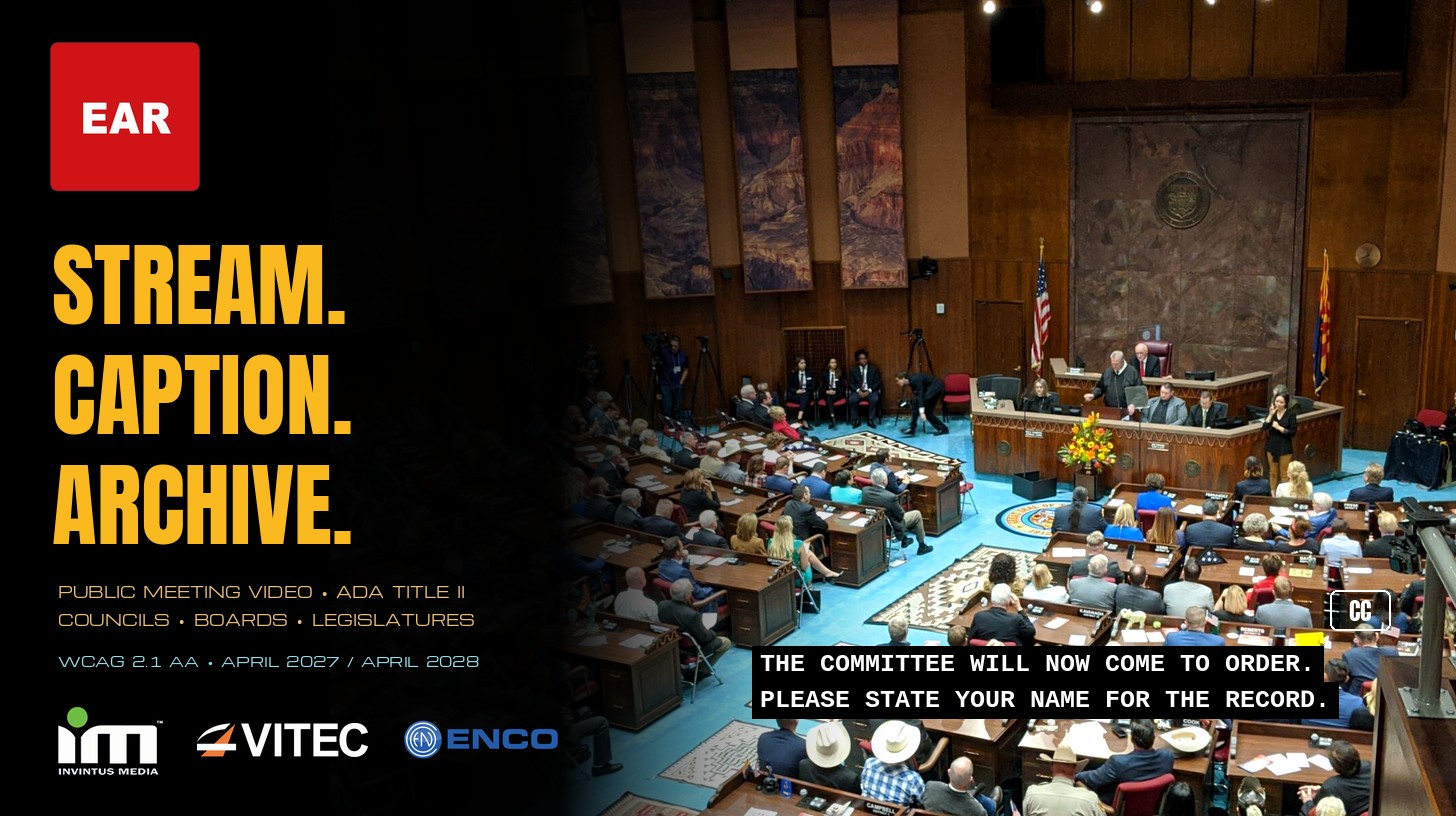
- Arizona State Legislature and Arizona Capitol Television: EAR Professional Audio Video integrated the Invintus streaming and archive platform, with live and on-demand closed captioning and more than 10,000 hours of archived meetings captioned, plus a 24/7 channel stream. Arizona Capitol Television runs live meetings on multiple ENCO vDesk systems (2026): each accepts HD-SDI and NDI video, audio and control, and handles cameras, audio, video and graphics, including guest-laptop presentations, recorded content and vote tallies. Saved camera positions for each member or seat let one operator manage a meeting with one button per shot. See the hearing-room case study.
- Arizona House of Representatives: a VITEC EZ TV IPTV system with MGW Diamond-H HEVC encoders and ChannelLink, with configuration and training (2024–2025).
- City of Glendale: council chamber rebuilt in 2026, with meetings carried on Glendale’s government channel with English and Spanish captions and the captioned program returned to the chamber displays.
- City of Phoenix: council chamber broadcast systems for City Channel 11 since 2012.
- Arizona Medical Board: Invintus live and on-demand meeting streaming platform and support, so the public can watch board meetings live and on demand. The Arizona State Board of Pharmacy also uses this meeting streaming capability.
Getting ready: a five-step plan
- Inventory every place meeting video appears: your website, streaming platform, YouTube or social media, and the government channel.
- Sort the archive: decide which pre-deadline recordings stay public as current content (caption them) and which move to a clearly labeled archive.
- Choose a caption method for live meetings, professional or speech recognition with review, and confirm it reaches every outlet.
- Check the chain: encoders, streaming platform and players must pass CEA-608/708 captions and have accessible controls.
- Fix the room: clear audio and good camera coverage make every caption method more accurate.
Frequently asked questions
When do cities and counties have to meet the ADA Title II web accessibility rule?
Under the U.S. Department of Justice rule (28 CFR part 35, subpart H), as extended by an interim final rule published April 20, 2026, state and local government entities with a total population of 50,000 or more must comply by April 26, 2027. Entities under 50,000 and all special district governments must comply by April 26, 2028. The technical standard is WCAG 2.1 Level AA.
Do live-streamed council and board meetings need captions?
Yes, when the meeting video is part of the entity’s web content. WCAG 2.1 Level AA includes Success Criterion 1.2.4, captions for live audio in synchronized media, and the Justice Department declined to delay that requirement, calling it crucial for access to live services. Recorded meetings posted online need captions under Success Criterion 1.2.2, and audio description applies to prerecorded video under 1.2.5.
Are older meeting videos in our archive exempt?
Possibly. The rule’s archived web content exception requires all four conditions: the video was created before the entity’s compliance date, it is kept only for reference, research or recordkeeping, it is not altered or updated after archiving, and it is stored in an area clearly identified as archived. Meetings held after the compliance date are not covered by the exception, and an archived video may still need to be captioned when someone with a disability requests it.
Are automatic captions enough?
The Justice Department did not set a caption accuracy level or method. It noted concerns that automatic captions are not yet accurate enough in many contexts and pointed to W3C guidance that automatic captions are not sufficient on their own unless confirmed to be fully accurate. Many legislatures use professional live captioners or reviewed captions; the right method depends on the meeting and the budget.
If a vendor hosts our meeting video, are we still responsible?
Yes. The rule covers web content a public entity provides directly or through contractual, licensing or other arrangements, so a contracted streaming or archive platform must meet the standard. Choose platforms that carry CEA-608/708 captions and have accessible players.
Who can help an Arizona city or county caption, stream and archive public meetings?
EAR Professional Audio Video, in Tempe, Arizona, designs, installs and supports meeting video systems for legislatures, councils and boards: chamber cameras and audio, caption encoding, streaming and archive platforms such as Invintus, IPTV and encoders from VITEC, and ENCO vDesk single-operator meeting production. Its work includes the Arizona State Legislature and Arizona Capitol Television, the Arizona Medical Board and the Arizona State Board of Pharmacy. At the Legislature, meetings are streamed with live and on-demand closed captioning. Agencies can buy through Arizona state contract CTR075309 or national cooperative contract 1GPA 22-02PV.
Related: Hearing rooms and council chambers · Legislative AV infrastructure · PTZ camera systems · Audio description deadlines · Remote broadcast connectivity · Arizona state contract
Sources: DOJ interim final rule, 91 FR 20902 (April 20, 2026); DOJ final rule, 89 FR 31320 (April 24, 2024); 28 CFR part 35, subpart H (eCFR); ADA.gov fact sheet; ADA.gov small entity compliance guide; WCAG 2.1; Invintus streaming platform; VITEC EZ TV; VITEC MGW Diamond-H datasheet; ENCO vDesk; Telestream CaptionMaker; Telestream Kumulate; EAR Professional Audio Video project records. Manufacturer information November 2026, subject to change. Banner photo: EAR Professional Audio Video (captions simulated); logos: Invintus Media, VITEC, ENCO. Last reviewed: November 6, 2026.
About EAR
EAR Professional Audio Video (Engineering & Recording, Inc.) is a broadcast and professional AV systems integrator and reseller in Tempe, Arizona, founded in 1978. EAR designs, installs and supports systems for government, education, broadcast and corporate clients, and is an awarded supplier on Arizona state contract CTR075309 and national cooperative contract 1GPA 22-02PV.
EAR Product & Services